Internal Smart India Hackathon 2026
The Department of Computer Science and Engineering (Artificial Intelligence & Machine Learning), Department of Computer Science and Engineering (Cyber Security), and Department of Information Technology, in association with the Institution’s Innovation Council (IIC) and Innovation and Entrepreneurship Cell, organized the Internal Smart India Hackathon (SIH) 2026 on 22nd August 2026 at Finolex Academy of Management and Technology (FAMT), Ratnagiri.
The event was conducted at the IT Seminar Hall, EN 1/5, Computer Centre Lab 1, Computer Centre Lab 2, and EN 0/6. A total of 65 teams participated in the internal hackathon, and their innovative ideas were evaluated by a panel of 14 jury members. Following the evaluation process, 35 teams were shortlisted for the next round of Smart India Hackathon 2026.
The Internal Smart India Hackathon was organized with the objective of providing students with a platform to identify real-world problems, develop innovative technology-driven solutions, and demonstrate their skills in problem-solving, creativity, teamwork, technical communication, and entrepreneurship. The event encouraged students to move beyond conventional classroom learning and apply their technical knowledge to practical and societal challenges. The participating teams worked on diverse problem statements related to Artificial Intelligence and Machine Learning, Cyber Security, Smart Automation, Agriculture, HealthTech, Transportation and Logistics, Data Analytics and GIS, Sustainable Development, Digital Transformation, Heritage and Culture, and other emerging technology areas.
Prior to the event, extensive preparations were undertaken by the organising departments, including student orientation, team formation, registration, verification of team details, venue allocation, jury coordination, preparation of evaluation criteria, technical arrangements, and coordination among faculty members, student volunteers, jury members, and technical support staff. These preparations helped ensure the smooth and systematic conduct of the hackathon across multiple venues.
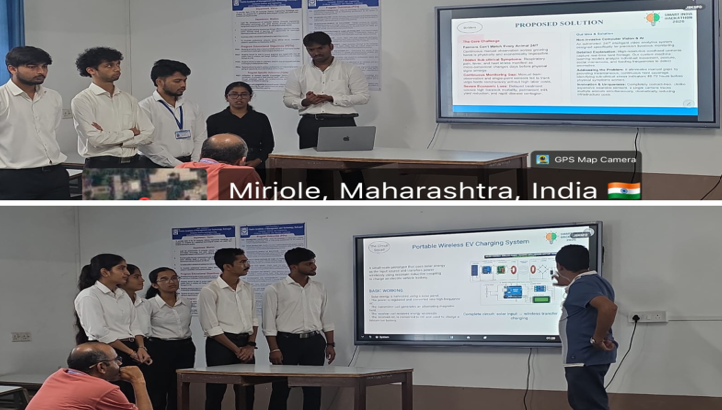
During the hackathon, participating teams presented their proposed solutions before the jury members. The teams explained the identified problem, background and significance, proposed technological solution, novelty and innovation, system architecture and methodology, technologies and tools, expected outcomes, feasibility, scalability, potential users, and future scope. The jury members interacted with the students through technical and conceptual questions and provided valuable feedback and suggestions for further improvement.
