 Skip to main content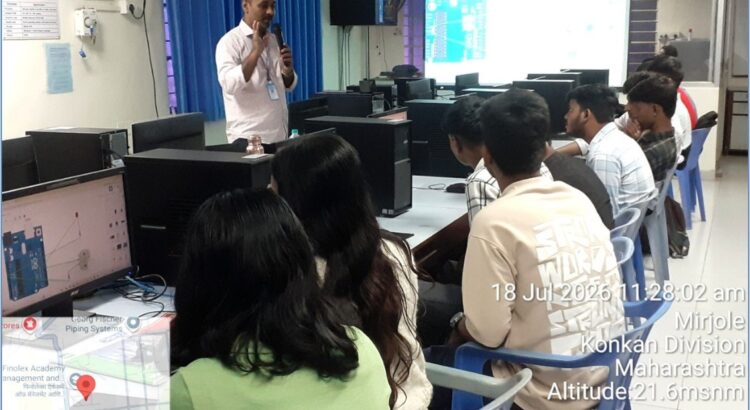
Hands-on Workshop on Arduino, Sensor Interfacing and Mini Project Development
The Department of Electrical Engineering organized a two-day “Hands-on Workshop on Arduino, Sensor Interfacing and Mini Project Development” for Second Year Electrical Engineering students on 18th and 21st July 2026.
The workshop was conducted by Prof. Rupesh B. Ingle, Assistant Professor, Department of Electrical Engineering. A total of 52 Second Year Electrical Engineering students participated in the workshop.
The objective of the workshop was to develop students’ fundamental knowledge and practical skills in Arduino-based system development and encourage them to use Arduino in their Semester III mini-projects.
During the workshop, students were introduced to the Arduino UNO board, Arduino IDE, basic programming concepts, digital and analog input/output operations, sensor interfacing and the development of simple Arduino-based applications. Students performed hands-on activities involving circuit connections, program development, uploading code and testing the output.
The workshop also provided guidance on selecting mini-project topics, identifying the required components, integrating sensors and actuators, troubleshooting hardware and programming errors, and developing complete Arduino-based project solutions.
The workshop was conducted under the valuable guidance and support of Dr. Jayant J. Mane, Head, Department of Electrical Engineering. Mr. Parashuram More, Lab Assistant, provided valuable support in arranging the laboratory facilities and equipment required for the workshop.
Students actively participated in the hands-on activities and gained valuable experience in Arduino programming, sensor interfacing and mini-project development. The workshop enhanced their confidence in applying theoretical concepts to practical engineering applications.
The students provided positive feedback and stated that the hands-on approach made microcontroller and Arduino concepts easier to understand. They found the workshop helpful in strengthening their hardware interfacing and programming skills. It also motivated them to explore and develop more Arduino-based applications and projects.

