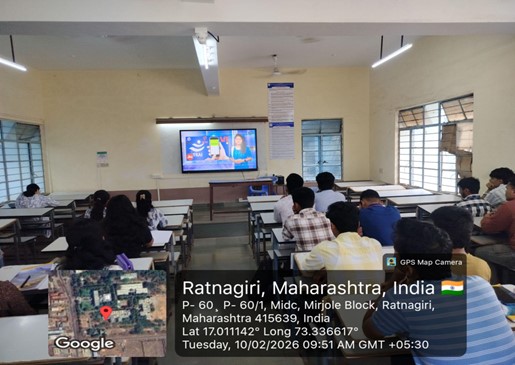
Awareness Session on Online Safety, Cyber Hygiene, And Safe & Responsible Use of the Internet and Artificial Intelligence
An Awareness session on “Online Safety, Cyber Hygiene, and Safe & Responsible Use of the Internet and Artificial Intelligence” was organized by the Computer Science and Engineering (CS) Department at Finolex Academy of Management and Technology, Ratnagiri, on 10th February 2026 at 09:15 AM, in EN 1/15.
Safer Internet Day is celebrated globally on the second Tuesday of February to promote the safe and responsible use of the internet, particularly among children and young people. Each year, this initiative highlights emerging online issues and current cybersecurity concerns. In line with the national observance of Safer Internet Day 2026 under the theme “Smart Tech, Safe Choices – Exploring the Safe and Responsible Use of AI”, an awareness session was successfully conducted for Second Year (SE) Cyber Security students on 10th February 2026, with 36 students actively participating. This initiative aligns with the objectives of the Ministry of Electronics and Information Technology (MeitY) under the Information Security Education and Awareness (ISEA) Project, which aims to sensitize citizens about cyber threats, promote cyber hygiene, and encourage responsible use of digital technologies.
The session focused on creating awareness about the increasing use of Artificial Intelligence by cyber criminals to carry out sophisticated scams. A series of informative and real-life-based videos were presented to the students to help them understand the nature, impact, and seriousness of such cyber threats. The videos shown during the session included Beware of AI Scam Alert: Fake Cop Tricks Woman, Claims Her Daughter Arrested, Cyber Criminals Use AI to Clone Voice and Scam Woman of Rs 32,000, TRAI’s New AI Spam Filters Will Provide Relief from Spam Calls and Messages, and Paise Ki Demand Aayi… Awaaz Apne Bacche Jaisi Thi!. These videos highlighted various cyber fraud techniques such as voice cloning, impersonation, emotional manipulation, panic-based scams, and spam-based financial fraud.
The interactive discussion encouraged students to actively participate by sharing their thoughts, experiences, and queries related to cyber fraud and online safety. This interaction helped reinforce practical understanding and enhanced awareness regarding responsible online behavior. The session contributed significantly towards strengthening students’ cyber security knowledge, critical thinking, and preparedness to tackle evolving digital threats.
The session was coordinated by Prof. Mahesh A. Jadhav, Assistant Professor, Department of CSE (Cyber Security), under the guidance of Prof. V. V. Nimbalkar, Head of the CSE (Cyber Security) Department.
Read More
